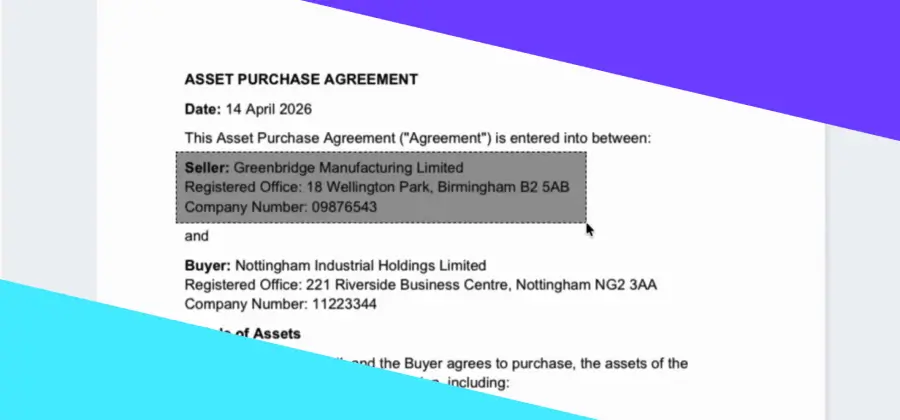

At matter intake, lawyers are often asked to assess prospects quickly based on incomplete and disorganised material. Early decisions about whether to act, how to scope the matter and what strategy to pursue are frequently made before a full evidentiary review is possible. Legal Ready enables firms to use in-platform AI to rapidly triage new matters by organising intake material, surfacing factual gaps and inconsistencies, and producing a structured, evidence-linked overview of strengths and risks. This allows senior lawyers to make earlier, better-informed decisions while maintaining full professional oversight.
The Scenario
At the start of a potential dispute, firms are commonly provided with:
- client emails and correspondence,
- draft affidavits or witness statements,
- contracts or financial records,
- screenshots, PDFs or informal documents.
This material is rarely complete or coherent. Yet early judgments must be made about:
- prospects of success,
- evidentiary gaps,
- likely cost and complexity,
- whether the matter should proceed at all.
Manually reviewing and synthesising intake material can take many hours, delaying advice and increasing the risk that early strategic decisions are made without a full understanding of the factual landscape.
The Solution
Using eBrief Ready, Litigation Ready or Disclosure Ready, legal teams can perform an early merits triage using in-platform AI, without exposing any material to external systems.
Step 1: Secure Intake and Organisation
All intake material is uploaded into a new matter. Smart Classification automatically identifies document types, applies consistent naming and numbering, and organises files into a clear evidentiary structure.
Step 2: Factual Extraction and Structuring
Using the Analyse function, the AI extracts:
- key factual assertions made by the client,
- relevant dates, parties and transactions, and
- references to documents relied upon to support those assertions.
This creates a clear, document-anchored picture of what is actually evidenced at intake – as distinct from what is merely asserted.
Step 3: Gap and Risk Identification
The AI can then be prompted to identify:
- missing documents required to substantiate key elements of the claim or defence,
- internal inconsistencies across the intake material, and
- factual assumptions not yet supported by evidence.
All findings are footnoted to source documents and confined strictly to the uploaded material.
How This Applies
Within minutes, the legal team has access to:
- a structured intake summary of the matter,
- an evidence-linked outline of strengths and weaknesses, and
- a clear checklist of missing or required material.
These outputs can be used to:
- advise the client on prospects at an early stage,
- determine whether the matter should proceed,
- scope the work and manage expectations, and
- plan targeted next steps for evidence gathering or early resolution.
Because every point is traceable to source material, partners can confidently rely on the analysis without needing to reread the entire intake bundle.
Key Takeaways
Earlier clarity: Partners gain a defensible view of merits before committing significant resources.
Better risk management: Factual gaps and inconsistencies are identified early, not months into the matter.
Improved efficiency: Reduces hours of manual intake review to minutes.
Client confidence: Advice is grounded in documents, not assumptions.
Human in the loop: Legal Ready’s products support factual triage; legal judgement and strategy remain with the lawyer.
The Difference
The Standard Way
When a new matter arrives, lawyers manually review a mixed bundle of emails, documents and draft statements. Initial assessments rely heavily on summaries prepared under time pressure, client narratives that may not yet be tested against documents, and assumptions about what evidence will emerge later. Strategic decisions are often deferred – or made with limited visibility of factual risk.
The Legal Ready Way
Matter intake material is uploaded and organised immediately. The AI extracts key facts, highlights internal inconsistencies, identifies missing evidence and presents a structured, document-linked overview of the case within minutes. Partners can assess prospects, scope risk and plan next steps with clarity before significant time or cost is incurred.
We’d love readers to share their own use cases for the benefit of the broader legal community. If you have questions about Legal Ready’s AI features or would like a demonstration connect with us directly. We are also happy to talk about AI safety generally. In this series, we’re showcasing real ways all lawyers can use Legal Ready to deliver safer, faster, more accurate legal work.